The Physics and Economics of Orbital Data Centers
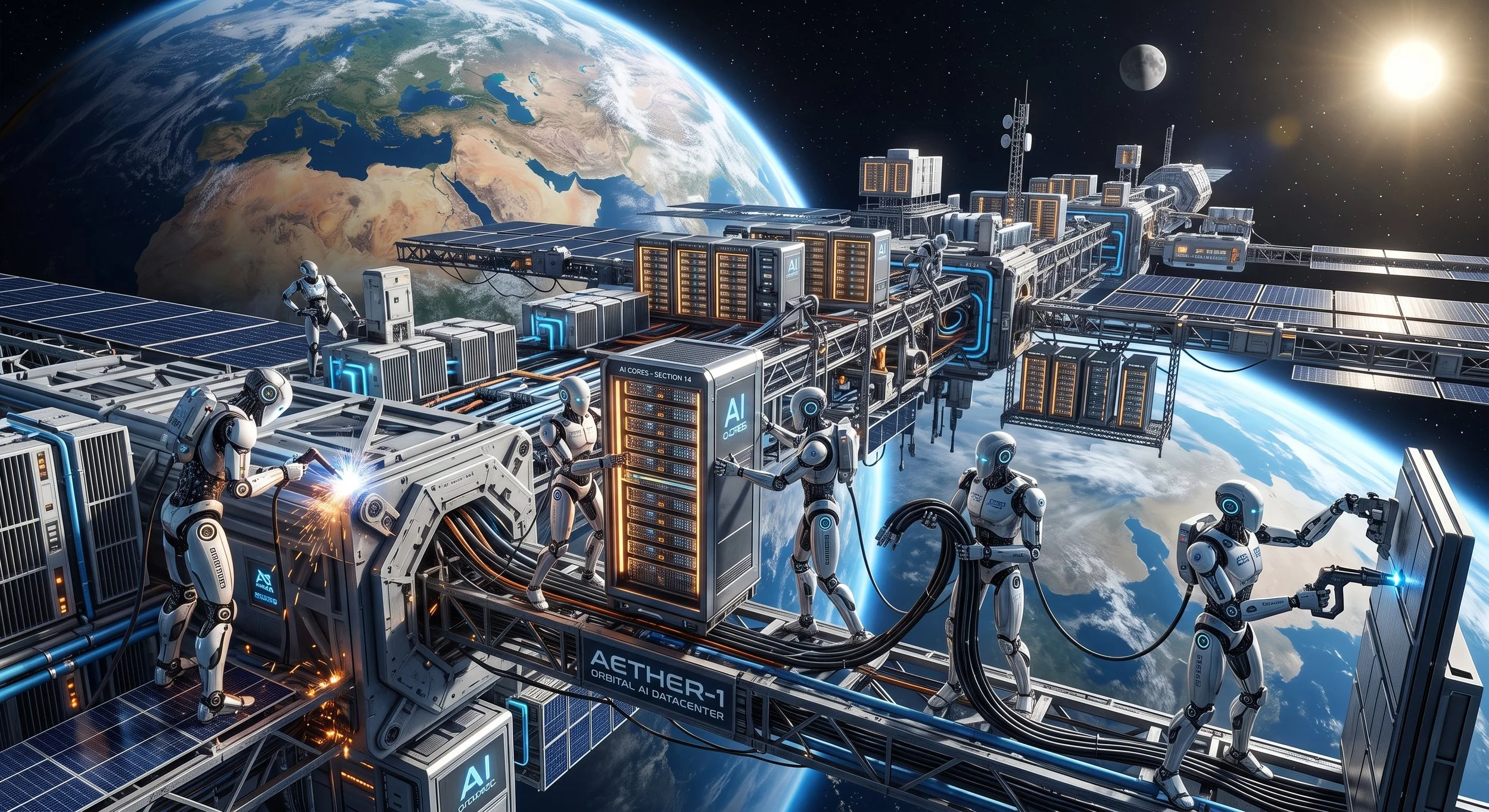
Data Centers in the Stars: Why the Future of AI is Moving Above the Cloud
The expansion of artificial intelligence is colliding with a hard physical reality: Earth is running out of room, and soon resources. In 2025, global data center energy consumption reached approximately 415 TWh. We are currently on a trajectory to double global compute capacity by 2030, a demand curve driven almost exclusively by the power-hungry nature of Large Language Models. This is not a cyclical dip in availability; it is a structural crisis.
In premier markets like Tokyo and Amsterdam, grid connection timelines for new facilities have stretched to a staggering ten years. Even when power is accessible, the competition for land and the local resistance to water usage, despite advances in closed-loop systems, have created a terrestrial bottleneck. These constraints have transformed "orbital compute" from a science-fiction curiosity into an engineering necessity. We are witnessing the birth of "orbital economics," a shift driven by the need to bypass the terrestrial grid entirely and tap into the near-continuous solar radiation available in Low Earth Orbit (LEO).
1. Functional Specialization (The Architectural Split)
The migration to space will not result in the abandonment of terrestrial infrastructure. Instead, the industry is entering a phase of "architectural bifurcation." The future of data center design depends on a clear division between "latency-sensitive" workloads and "latency-tolerant" processes.
Real-time inference and user-facing applications will remain anchored to Earth to maintain proximity to the end-user. Conversely, space is becoming the primary candidate for asynchronous, energy-heavy workloads such as large-scale AI training. However, this creates a fascinating strategic challenge: the "Cycles of Silicon vs. the Cycles of Aerospace." While AI chips like Google’s Trillium TPUs or Nvidia’s Blackwell architecture advance on a 1-to-2-year cycle, the typical lifespan of a satellite is 5 to 7 years. Navigating this mismatch is the new moat for infrastructure strategists. As JLL research notes:
“The future is not replacement, but functional specialization: orbital systems handling asynchronous, energy heavy workloads, while Earth based data centers retain dominance in real time computing.”
2. The "Physics Tax" of the Vacuum
While space is colloquially thought of as "cold," it is actually a perfect insulating vacuum that makes cooling a significant hurdle. On Earth, we rely on air or water for convection to move heat away from servers. In space, those mechanisms are off the table.
The governing constraint is the Stefan-Boltzmann Law, which dictates that in a vacuum, heat can only be rejected via radiation. This leads to a brutal "physics tax": to keep a high-performance chip at a stable 60°C, you need massive surface area to bleed off the energy. For context, a single 40kW server rack requires an 80-square-meter radiator—roughly the size of a pickleball court.
Furthermore, this tax increases over time. Exposure to UV light and atomic oxygen in LEO degrades radiator coatings, causing a 40% rise in the physics tax toward the end of a satellite’s life. To compensate, operators must launch 40% more radiator mass than initially required just to ensure the system survives its 5-year mission. This trade-off—zero water use versus massive upfront CapEx for radiator mass—is the defining engineering hurdle of the orbital cloud.
3. The $500/kg Economic Inflection Point
The viability of space-based compute is inextricably linked to launch costs, and we are nearing a critical financial threshold. Current Falcon 9 launch costs sit around $2,700/kg, but the target for SpaceX’s Starship is $200/kg—a 93% reduction.
According to McKinsey and Starcloud research, $500/kg is the "inflection point" where space-based compute becomes cost-competitive with terrestrial alternatives. At $200/kg, it becomes structurally cheaper. This is driven by a powerful "learning curve": the price per kilogram falls by approximately 20% for every doubling of cumulative mass launched. For investors, the potential upside is massive. Starcloud estimates that a 40 MW cluster operated in space over 10 years could save $138 million in energy costs compared to a terrestrial equivalent, assuming a terrestrial power price of $0.04/kWh.
4. Solving the "Downlink Bottleneck"
A common misconception is that orbital data centers are designed solely to beam data back to Earth. In reality, their most immediate value lies in processing data where it is born. Modern Earth Observation (EO) satellites, equipped with hyperspectral and synthetic aperture radar (SAR) sensors, generate terabytes of raw data daily—a volume that terrestrial radio-frequency "pipes" simply cannot absorb.
By placing high-performance compute units like Axiom Space’s AxDCU-1 or Google’s Trillium TPUs directly in orbit, we shift from "downlinking raw data" to "downlinking insights". Instead of sending a massive, raw hyperspectral image of a coastline to a ground station, the satellite processes the imagery in-situ and sends only the relevant coordinates or anomalies. This on-orbit processing reduces pressure on congested networks and enables real-time decision-making for missions ranging from disaster response to national security.
5. The Obsolescence and Debris Paradox
The most significant risk to this orbital vision is the dual threat of hardware obsolescence and the Kessler Syndrome, a cascading chain reaction of satellite collisions. The orbital environment is becoming increasingly crowded, with over 17,000 satellites currently in LEO. The urgency is already visible: the Starlink constellation now executes a collision avoidance maneuver every 2 minutes on average.
Without advanced, autonomous on-orbit decision-making, the risk of a multimillion-dollar data center becoming high-value "space junk" is a statistical certainty. As reports indicate:
“An estimated 44,000 tracked objects larger than 10 cm can destroy a satellite, and the Kessler Syndrome... poses a real and growing threat.”
This risk profile necessitates a shift toward "autonomous logistics," where in-orbit servicing and robotic upgrades become the baseline for protecting infrastructure that cannot be manually repaired by a technician.
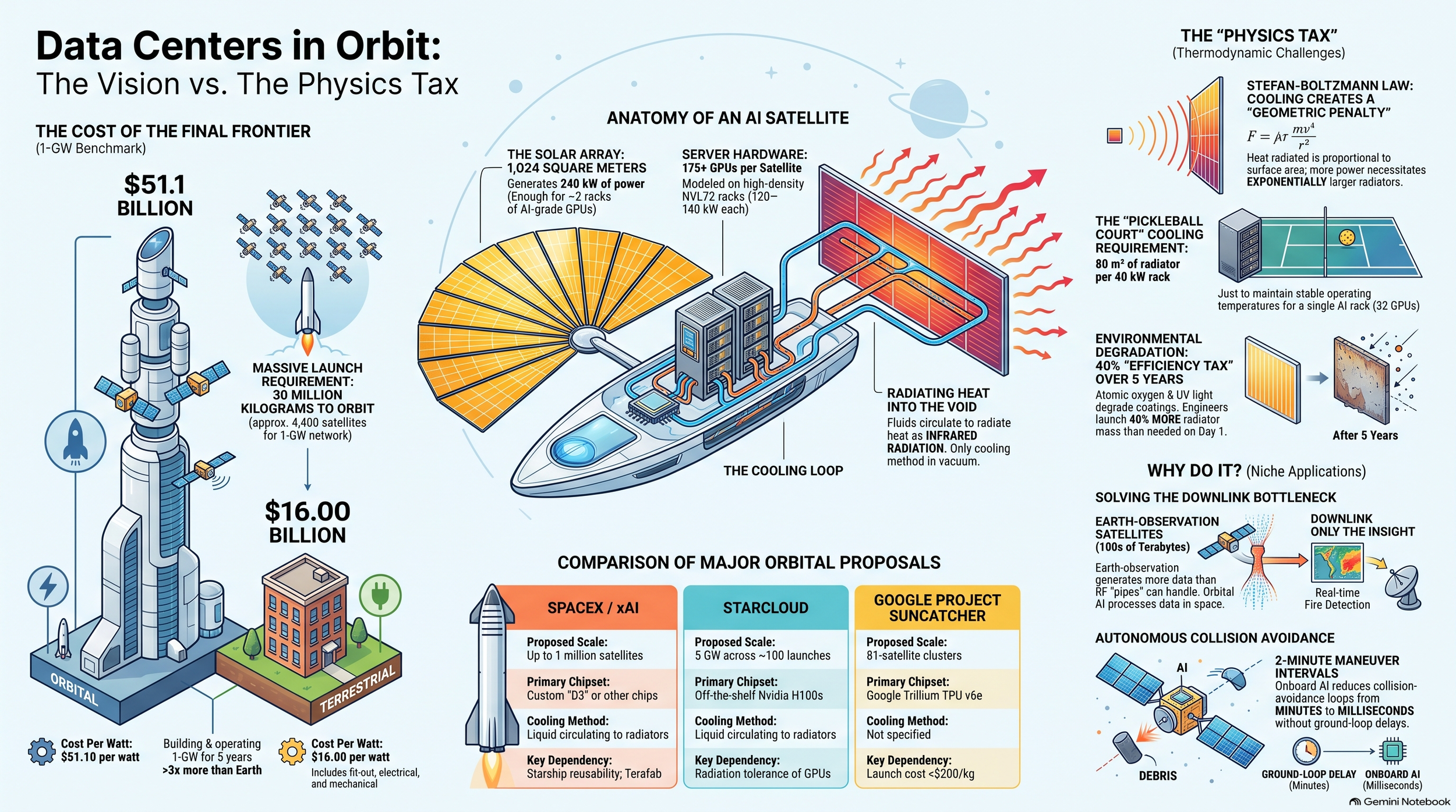
Orbital Data Center Feasibility Analysis
Conclusion: The Dawn of Autonomous Logistics
The transition of data centers to space is less about the silicon and more about the mastery of thermodynamics and launch economics. As we move away from the "launch and forget" era, the first movers, Starcloud, Axiom, Google, and SpaceX, are currently laying the foundation for a world where the network itself is the data center.
We are entering an era where space-based compute will be the backbone of the in-space economy. But as the infrastructure that powers our intelligence leaves the Earth's surface, it raises a final, provocative question for the strategists of the next decade: When the network itself becomes the data center and operates beyond national jurisdictions, who truly owns the sky?
